Last update: May 5, 2026
Navigating Chinatown, Dhoby Ghaut, and Raffles Place MRTs: An Accessibility Guide for Travellers and Locals
Singapore is often praised as one of the most accessible cities in Asia. Step-free walkways, barrier-free buses, tactile paving, and accessible MRT stations are now part of everyday life. However, even in a city that plans carefully for inclusion, some places remain a little more challenging to navigate, especially when history, dense urban development, and complex transport interchanges are involved.
This is where Chinatown, Dhoby Ghaut, and Raffles Place MRT stations come in.
These three stations sit right in the heart of Singapore’s oldest and busiest precincts. Long before accessibility standards became part of modern urban planning, these areas were already built up with narrow streets, conserved shophouses, underground utilities, and layered developments. Over the years, lifts, ramps, tactile guidance paths, and accessible toilets have been added. Still, due to space constraints, heritage conservation rules, and engineering limitations, not every exit can be made fully accessible.
As a result, navigating these stations can feel overwhelming, especially if you are:
- A wheelchair user
- Travelling with elderly family members
- Pushing a stroller or luggage
- Managing mobility, vision, or hearing needs
And if you are a tourist visiting Singapore for the first time, the maze of underground tunnels, multiple lines, and confusing exit numbers can turn what should be a short walk into a full-blown navigation challenge.
For disabled travellers, good planning often starts before arriving at the station. Beyond knowing which exits are step-free, it is also useful to understand the wider support and rights available when travelling. Skyscanner’s guide on inclusive travel rights for disabled people provides a helpful starting point for travellers planning an accessible trip.
That is exactly why this guide exists.
1. Chinatown
Planning a visit to Singapore’s Chinatown means stepping into one of the city’s most vibrant historic districts, where heritage shophouses sit alongside modern cafés, temples, markets, and hawker centres. While the area is well connected by public transport and has benefited from years of accessibility upgrades, its dense urban layout and conserved streets mean that not every route is entirely barrier-free. Knowing where to enter and which routes to take can make your journey far smoother.
Getting there by MRT
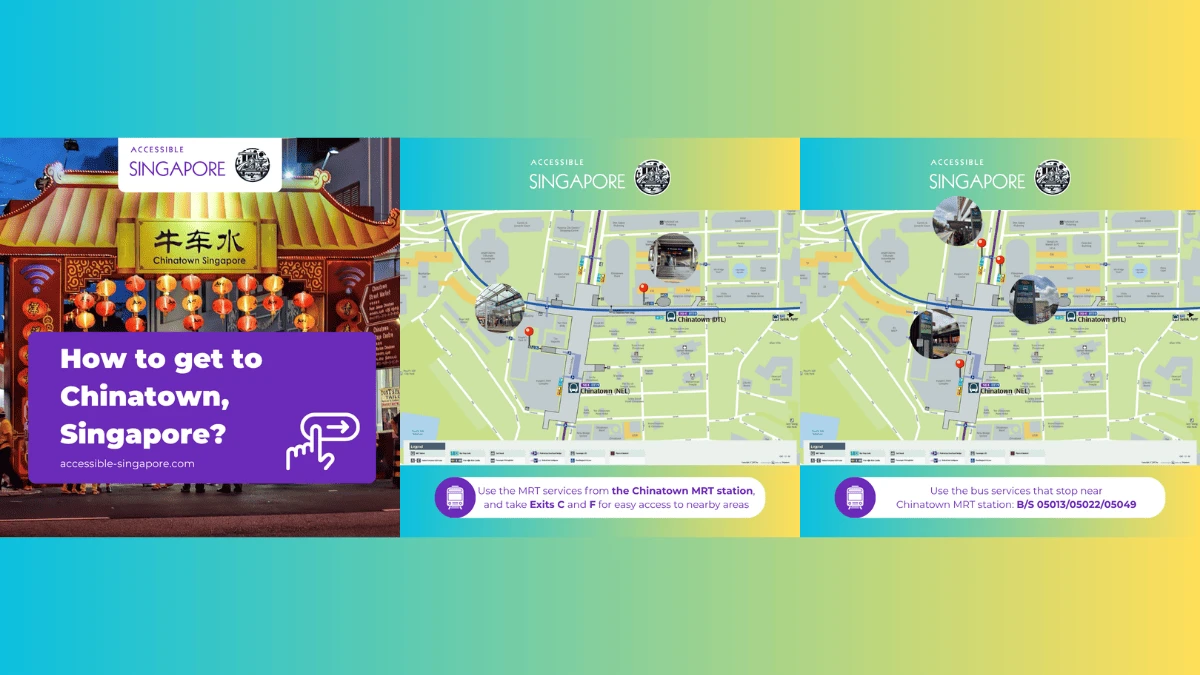
Chinatown MRT Station is an interchange station serving both the Downtown Line (DTL) and North East Line (NEL). Due to its underground depth and the surrounding built-up environment, only selected exits offer step-free access.
For barrier-free entry and exit, use:
- Exit C – Accessible via lift and connected directly to the main Chinatown street area
- Exit F – Also lift-accessible and convenient for accessing nearby shops and attractions
These exits place you within easy reach of Pagoda Street, Smith Street, Chinatown Complex, and surrounding heritage lanes.
If you are travelling with a wheelchair, stroller, or mobility aid, it is recommended to plan your route specifically around these two exits, as some other exits involve stairs or long underground walkways.
Getting there by bus
For those who prefer above-ground travel or want to enjoy the city views along the way, several bus services stop directly around Chinatown MRT Station.
Key accessible bus stops include:
- Chinatown Stn Exit C (05013) – along Eu Tong Sen Street
- Chinatown Stn Exit E (05049) – along New Bridge Road
- Aft Chinatown Stn Exit D (05022) – along Eu Tong Sen Street
All public buses in Singapore are wheelchair-accessible, with deployable ramps and priority seating. Most bus stops in the area are equipped with sheltered waiting areas and tactile guidance paths.
Moving around Chinatown
Chinatown has seen major upgrades in recent years to improve pedestrian accessibility. Visitors can expect:
- Wide, step-free walkways along major streets
- Upgraded pedestrian crossings with tactile paving
- Traffic-calmed roads in key heritage zones
- Barrier-free access to many attractions, shopping areas, and food centres
That said, some older backstreets and conserved shophouse lanes may still have narrow walkways or uneven surfaces. If you are navigating independently, it is best to stick to main streets such as Pagoda Street, Smith Street, Temple Street, South Bridge Road, and Eu Tong Sen Street, where accessibility infrastructure is more consistent.
2. Dhoby Ghaut
Dhoby Ghaut is one of Singapore’s busiest and most strategically located MRT interchanges. Sitting at the gateway to Orchard Road, Bras Basah, Fort Canning, and the civic district, it connects three major lines, the North South Line (NSL), North East Line (NEL), and Circle Line (CCL). It is also directly linked to Plaza Singapura, one of the city’s most popular shopping malls.
Because of its size, depth, and multiple underground levels, Dhoby Ghaut can feel overwhelming, particularly for first-time visitors. However, the station is fully accessible, with step-free routes, tactile guidance paths, and lifts connecting platforms, concourses, and exits. With the right exit and a clear plan, navigating Dhoby Ghaut is straightforward and efficient.
Getting there by MRT
Dhoby Ghaut MRT Station is fully wheelchair accessible across all three lines. Lifts connect the platforms to the concourse, and tactile guidance paths run throughout the station to assist commuters with visual impairments.
When exiting the station, selecting the correct exit will significantly reduce walking distance and simplify your journey.
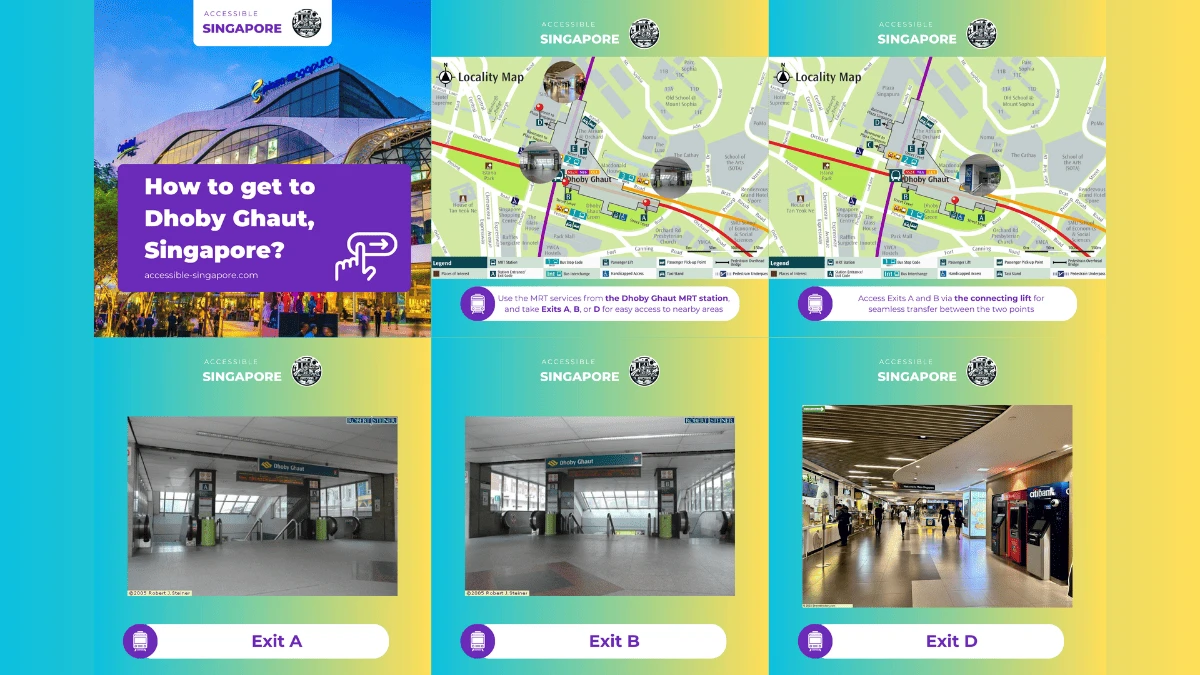
- Exit D – Plaza Singapura: This exit provides direct step-free access into Plaza Singapura shopping mall. It is the most convenient route for visitors heading to retail stores, cinemas, restaurants, and cafés. The mall itself is fully accessible, with lifts serving all floors and barrier-free washrooms.
- Exits A and B – Dhoby Ghaut Green and Fort Canning Hill: These exits lead toward Dhoby Ghaut Green, Fort Canning Park, and nearby arts and heritage attractions. Both exits are connected via a shared lift, allowing wheelchair users and travellers with mobility aids to move smoothly between the two without encountering stairs.
This makes the area an excellent starting point for visits to the National Museum of Singapore, Fort Canning Park, and the Bras Basah arts district.
Getting there by bus
For those who prefer above-ground travel, Dhoby Ghaut is also well served by public buses. All bus stops around the station are wheelchair accessible and equipped with sheltered waiting areas. Singapore’s public buses feature deployable ramps and designated wheelchair spaces, making transfers between bus and MRT seamless.
Bus services from Dhoby Ghaut provide direct connections to Orchard Road, City Hall, Bugis, Little India, and the Singapore River.
Accessibility highlights
Dhoby Ghaut has been progressively upgraded to support Singapore’s inclusive transport network. Key accessibility features include:
- Step-free access between all MRT lines
- Lifts serving platforms, concourses, and street-level exits
- Tactile guidance paths throughout the station
- Barrier-free access to Plaza Singapura
- Sheltered and accessible bus stops
3. Raffles Place
Raffles Place sits at the very heart of Singapore’s Central Business District. On any weekday, the area is a fast-moving mix of office workers, visitors, tourists heading to the Singapore River, and families making their way to Merlion Park. Beneath the skyline of banks and corporate towers lies one of the MRT network’s busiest interchange stations, connecting the East West Line (EWL) and North South Line (NSL).
Because Raffles Place was built long before modern accessibility standards were introduced, its underground layout is extensive and layered. Over time, barrier-free features such as tactile guidance paths, ramps, and lifts have been carefully added. However, step-free access is concentrated around specific routes and building-linked exits. Knowing which path to take makes a significant difference in your journey.
Getting there by MRT
Raffles Place MRT Station is fully accessible; however, due to its size and high passenger volume, navigation can feel complex during peak hours.
Upon exiting the train:
- Follow the directional tactile guidance paths on the platform floor.
- These will guide you to the lift that connects the platforms to the main concourse.
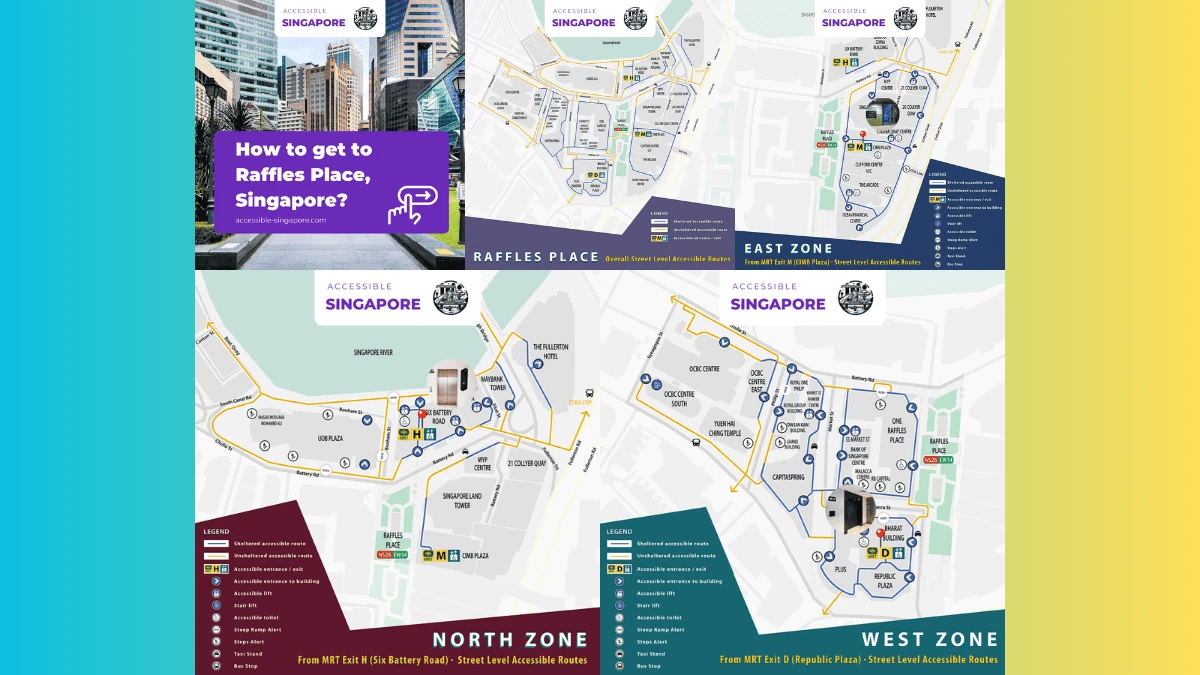
- After tapping out at the fare gates, take the lift down to Basement 1 (B1), where the accessible routes to street level begin.
From B1, several step-free paths lead to nearby office buildings and street-level exits.
Street-level access routes
Raffles Place station is integrated into surrounding commercial buildings, which provide sheltered and accessible pathways to ground level.
Via Exit M (CIMB Plaza)
From the B1 lift:
- Enter the adjacent basement retail area
- Take the route on the left
- The lift lobby to street level will be on your right
This route provides direct access to Raffles Place MRT Exit M and the surrounding financial district.
Via Exit H (Six Battery Road)
From the B1 lift:
- Head right toward Exit H
- Look for the ramp entrance into Six Battery Road on your right
- This leads directly to the lift lobby serving street level
This exit is convenient for accessing Battery Road, Fullerton Road, and the Singapore River promenade.
Via Exit D (Republic Plaza)
- Follow the tactile guidance path to the junction near the washrooms
- Head toward Exit D
- Enter Republic Plaza on your right
- A ramp leads you to the building’s lift lobby for street access
This route is useful for those heading toward Raffles Place Park, One Raffles Place, and nearby office towers.
Accessibility highlights
Raffles Place has been designed to support Singapore’s high-volume commuter flow while maintaining accessibility for all users.
Key features include:
- Tactile guidance paths throughout the station
- Step-free routes between platforms, concourses, and street level
- Barrier-free building entrances
- Covered walkways between MRT exits and office towers
Lifts at CIMB Plaza and Six Battery Road operate daily from early morning (around 5:30 am to 6:00 am) until approximately 12:15 am. Lifts within Republic Plaza operate primarily during office hours.