Last update: June 12, 2026
Serviced Apartments vs. Hotels: Accessibility for Your Singapore Trip
Choosing where to stay in Singapore can make or break how easy your trip feels. For travellers with mobility needs, sensory needs, elderly family members, or caregiving responsibilities, accommodation is not just about comfort—it shapes how you move, rest, eat, and manage your day.
The main choice is often between a hotel and a serviced apartment.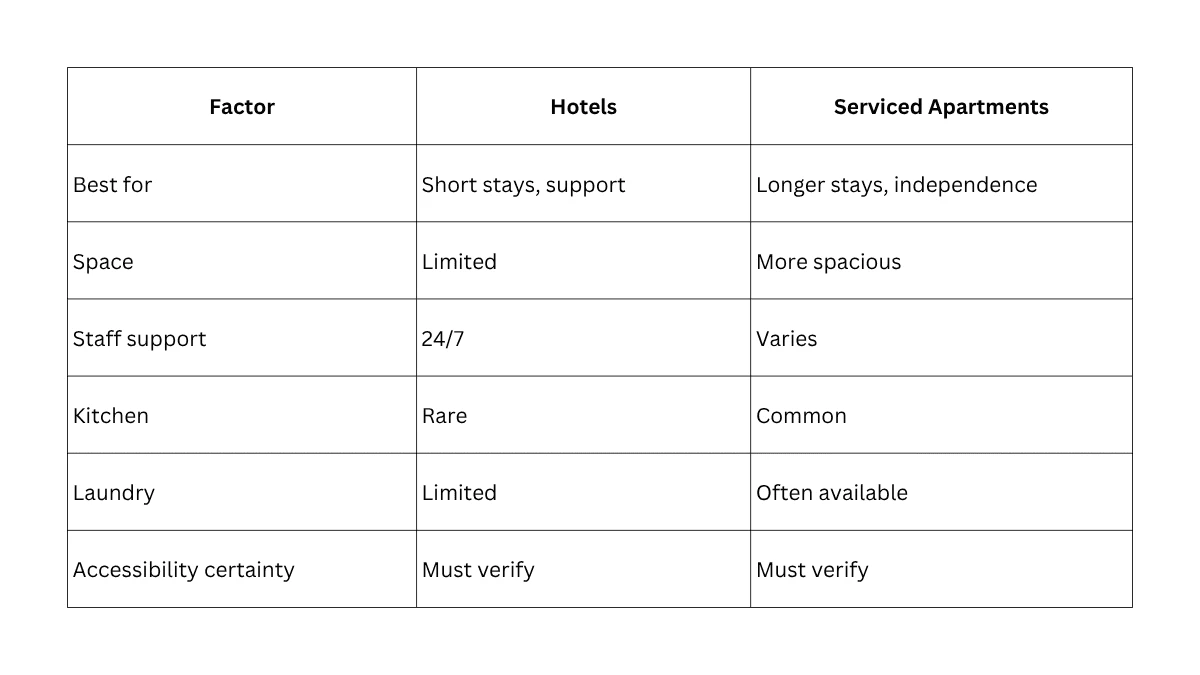 Hotels usually provide stronger on-site support. A 24-hour front desk, concierge, housekeeping, and luggage assistance can be useful if you need help quickly. Some hotels are also located directly above MRT stations or within integrated developments, reducing the need for outdoor transfers.
Serviced apartments offer a different kind of convenience. They may provide more space, separate living and sleeping areas, kitchen facilities, and laundry access. This can be especially helpful for longer stays, families, wheelchair users, caregivers, or visitors with dietary and medical needs.
There is no single best answer. For short stays and high-service needs, hotels may be easier. For longer stays and daily independence, serviced apartments may be more practical. The right choice depends on your mobility requirements, travel style, length of stay, and need for support.
The case for hotels: The luxury of immediate help
Hotels are often the better option for visitors who value service, location, and quick assistance.
A hotel usually has staff available throughout the day and night. This can be useful if the room setup needs adjustment, luggage needs to be handled, transport must be arranged, or accessibility details need to be clarified during the stay. For first-time visitors to Singapore, this level of support can reduce uncertainty.
Location is another major advantage. Fairmont Singapore, for example, is located above City Hall and Esplanade MRT stations, making it convenient for visitors who want access to public transport, shopping, dining, and central sightseeing areas. Staying close to MRT connections can reduce travel effort, especially in Singapore’s heat or sudden rain.
Marina Bay Sands is another example of a hotel that functions as a destination. The hotel, mall, restaurants, attractions, and waterfront areas are connected within one precinct. For visitors who prefer fewer transfers in a day, this type of integrated development can be practical.
Hotels may offer accessible room features such as wheelchair-accessible rooms, grab rails, emergency cords, lift access, and step-free common areas. However, these features are usually available only in selected room categories. Visitors should not assume that all rooms are accessible.
Before booking, contact the hotel directly and ask specific questions:
- Can a wheelchair move around the bed?
- Does the bathroom have a roll-in shower or a bathtub?
- Are grab rails available?
- Is there a shower chair?
- Can the bed height be confirmed?
- Is the route from the lobby to the room step-free?
- Is the nearest MRT connection step-free and sheltered?
- Are visual or audio alerts available if needed?
The main limitation of hotels is space. Even accessible hotel rooms may feel compact once luggage, mobility aids, medical equipment, or a caregiver are included. Dining and laundry are also less flexible unless the room has a kitchen or washing facilities.
In short, hotels are suitable for visitors who want immediate assistance, central locations, and easier access to transport and attractions.
The case for serviced apartments: Breathing room and home comforts
Serviced apartments are often more practical for visitors who need space, routine, and independence.
A serviced apartment may offer more floor area than a standard hotel room, depending on the property and room type. This can make movement easier for wheelchair users, visitors using walkers, families with strollers, or guests travelling with caregivers. Separate living and sleeping areas can also make the stay more comfortable, especially when more than one person is sharing the space.
Kitchen facilities are one of the biggest advantages. Visitors can prepare meals according to dietary needs, allergies, religious requirements, medical routines, or personal preferences. A kitchen also allows you to store snacks, medication, baby food, or simple meals, which can be useful after a long day outside.
Laundry access is another practical benefit. Many serviced apartments provide in-room washers and dryers or shared laundry facilities. For longer stays, this can be more convenient and cost-effective than hotel laundry services, which are often charged per item.
Serviced apartments can be especially useful for medical visits, family trips, relocation stays, extended holidays, or recovery periods. The apartment layout supports daily living rather than only short-term accommodation.
However, serviced apartments are not automatically more accessible than hotels. A larger room does not guarantee an accessible bathroom. Some apartments may have narrow shower entrances, raised thresholds, or limited grab rails. On-site support may also vary, and not every serviced apartment offers the same level of 24-hour assistance as a hotel.
Before booking, ask whether the building entrance is step-free, whether the lift can fit your mobility device, whether the bathroom is wheelchair friendly, whether kitchen counters are reachable, and whether laundry facilities are inside the unit or shared.
Serviced apartments are best for visitors who need more space, meal flexibility, laundry access, and a more home-like setup.
Singapore: Real-world property spotlights
The best choice depends on the property, location, and confirmed accessibility features. These examples show how hotels and serviced apartments can serve different visitor needs.
Ascott Orchard Singapore
Ascott Orchard Singapore is a serviced apartment option in the Orchard area. According to SG Enable, it is Singapore’s first serviced residence to receive the Building and Construction Authority’s Universal Design Mark Platinum certification. SG Enable also notes features such as sheltered walkways linked to nearby facilities, clear signage, braille, and tactile maps.
For visitors, the location is useful because Orchard Road has many shops, restaurants, clinics, malls, and transport options. It can also be busy, especially on weekends. Sheltered links and clear wayfinding can make movement easier in rain, heat, or crowded conditions.
Ascott Orchard may suit visitors who want an accessible serviced apartment in a central shopping district, especially for longer stays or trips involving family members and caregivers.
Pan Pacific Serviced Suites Orchard
Pan Pacific Serviced Suites Orchard lists a One Bedroom Deluxe (Wheelchair Friendly) suite category on its official website. This is useful because visitors can identify the wheelchair-friendly option directly when reviewing room types.
The one-bedroom suites include a separate living area, kitchenette, and ensuite bathroom. These features can support longer stays, meal preparation, medication routines, and more comfortable movement within the room.
The property also promotes wellness facilities such as a hydro-therapeutic spa and mineral water pool. Visitors who need accessible pool or spa access should check directly with the property before relying on these facilities, as room accessibility and facility accessibility may differ.
Pan Pacific Serviced Suites Orchard may be suitable for visitors who want more space, a kitchen, and a wheelchair-friendly serviced apartment category in the Orchard area.
Fairmont Singapore
Fairmont Singapore is a hotel option for visitors who prioritise service and transport connectivity. The hotel is located above City Hall and Esplanade MRT stations, making it convenient for travel to areas such as Marina Bay, Bugis, Raffles Place, and Orchard.
The hotel also highlights SwissPro filtered water dispensers in selected rooms and convention areas. This may be useful for visitors who need easy access to drinking water for medication, hydration, or daily routines.
Visitors should still confirm the exact accessible room type before booking. General room descriptions may not indicate whether a room has a roll-in shower, grab rails, or full step-free bathroom access.
Fairmont Singapore may suit short-stay visitors who want central MRT access, hotel support, and indoor links to shopping and dining.
Marina Bay Sands
Marina Bay Sands may suit visitors who want to stay within a major attraction precinct. The hotel, mall, restaurants, theatres, SkyPark, waterfront area, and Spectra light and water show are located within the same integrated district.
Accessible Singapore’s listing for Marina Bay Sands notes visitor-relevant features such as accessible public toilets, wheelchair-accessible hallways, visual and/or audible directional indicators, and wheelchairs available for borrowing.
This type of precinct can reduce the number of transfers needed in a day. Visitors can plan dining, shopping, sightseeing, and evening entertainment within one area. However, the property is large, so visitors should confirm room location, lift routes, bathroom layout, and distance to key attractions before booking.
Marina Bay Sands may be suitable for visitors who want convenience, attractions nearby, and fewer separate journeys during the day.
How to choose the right accessible stay for your Singapore trip
Hotels and serviced apartments serve different needs.
Choose a hotel if you are staying for a short period, want immediate assistance, prefer daily service, or need strong transport connections. Hotels are also practical for first-time visitors who want help with luggage, taxis, directions, and room requests.
Choose a serviced apartment if you are staying longer, travelling with family, using mobility equipment, managing dietary needs, or wanting more space and laundry access. Serviced apartments are often better when routine and independence are important.
Before booking either option, do not rely only on the word accessible. Ask for details in writing and, where possible, request photos of the room and bathroom. Confirm the shower type, grab rails, bed height, turning space, lift access, step-free routes, and distance to nearby transport.
The right accommodation does more than provide a place to stay—it removes friction from your entire trip. When chosen well, it gives you confidence, flexibility, and peace of mind to explore Singapore on your own terms.
Frequently asked questions
Are hotels or serviced apartments better for wheelchair users in Singapore?
It depends on the room layout and length of stay. Hotels may be better for short stays because they usually offer faster support. Serviced apartments may be better for longer stays because they often provide more space, kitchen facilities, and separate living areas. Always confirm bathroom layout, turning space, bed height, lift access, and step-free routes before booking.
Should I stay near an MRT station?
For most visitors, yes. Staying near an MRT station can reduce travel time and dependence on taxis. Visitors with mobility needs should also check whether the route from the accommodation to the MRT entrance is step-free, sheltered, and manageable in hot or rainy weather.
Is Orchard a good area for accessible accommodation?
Orchard can be practical because it has many hotels, serviced apartments, malls, restaurants, clinics, and transport options. It can also be crowded. Properties with sheltered links, clear signage, and nearby step-free access may be more convenient.
Is Marina Bay a good area for visitors with accessibility needs?
Marina Bay can be convenient because many attractions, restaurants, shops, hotels, and waterfront areas are close together. It may suit visitors who prefer fewer transfers. Before booking, check walking distances, lift access, room accessibility, and suitable viewing areas for shows or attractions.
What should I ask before booking an accessible room?
Ask specific questions. Does the room have a roll-in shower? Are grab rails available? Is there space beside the bed for a wheelchair transfer? Is the route from the lobby to the room step-free? Is the lift large enough? Is there a shower chair? Are visual or audio alerts available? Can the property provide room and bathroom photos?
Are serviced apartments good for families travelling with elderly relatives?
Yes. Serviced apartments may offer more space, kitchen facilities, laundry access, and separate living areas. These features can make caregiving, meals, and rest easier. Families should still confirm bathroom accessibility and lift access before booking.